The Astro PRO lunar calendar allows you to track its evolution daily, know the dates of the upcoming full and new moons, and identify special events like solar eclipses, apogee, and perigee.
You can also enable notifications to be alerted when a new moon or full moon begins.
What is a lunar calendar?
A lunar calendar displays the different phases of the Moon over the days.
The Moon completes a full cycle in about 29.5 days. During this period, the visible illuminated part from Earth gradually evolves: new moon, first crescent, first quarter, gibbous moon, full moon, then waning phase.
The Astro PRO calendar allows you to consult for each day:
- the current phase of the Moon;
- a visual representation of its illumination;
- the zodiac sign it is passing through;
- the date and time of the next full moon;
- the date and time of the next new moon;
- the periods of apogee and perigee;
- any potential solar eclipses.
Thus, you have a clear vision of the upcoming lunar cycle.
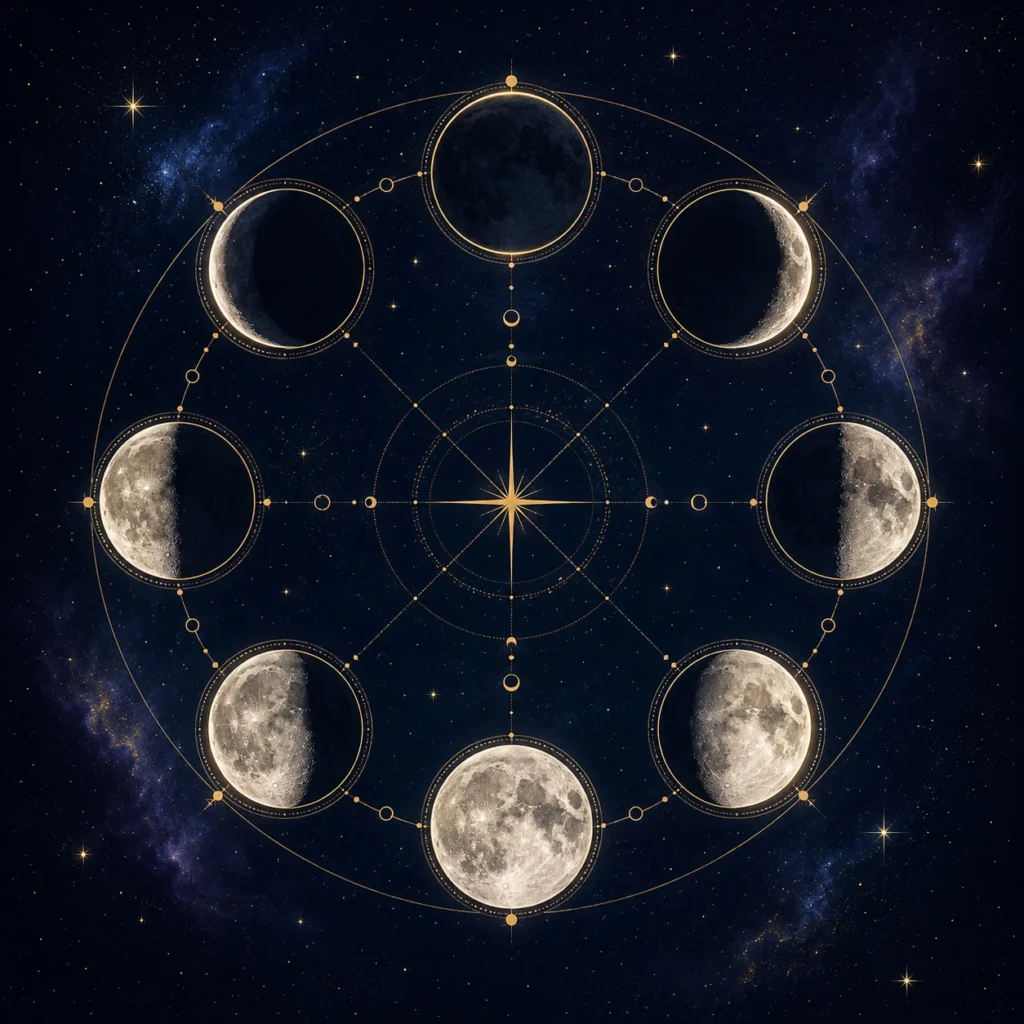
The eight main phases of the Moon
The lunar cycle consists of several successive stages.
New Moon
During the new moon, the Moon is positioned between the Earth and the Sun. Its illuminated side is facing away from the Earth, making it very difficult to see in the sky.
In astrological tradition, the new moon is associated with new beginnings, intentions, and projects that you wish to gradually nurture.
First Crescent
A thin, bright crescent reappears in the sky after the new moon.
This phase marks the beginning of the waxing cycle. It is often linked to initial actions, ideas taking shape, and decisions that allow you to progress.
First Quarter
The right half of the Moon is illuminated as seen from the northern hemisphere.
The first quarter corresponds to a period of progress. In an astrological reading, it can symbolize the need to take action, make choices, and overcome initial obstacles.
Waxing Gibbous Moon
More than half of the Moon becomes visible, though it has not yet reached full moon.
This phase is often related to adjustment, preparation, and the consolidation of efforts already made.
Full Moon
The Earth is positioned between the Sun and the Moon, whose visible side appears completely lit.
The full moon marks the peak of the lunar cycle. In astrology, it is generally associated with a time of awareness, emotional intensity, or culmination.
The Waning Gibbous Moon
After the full moon, the illuminated portion begins to gradually decrease.
This period can be used to reflect on the results achieved, share what has been learned, and start stepping back.
Last Quarter
The left half of the Moon appears lit from the northern hemisphere.
In astrological tradition, the last quarter corresponds to a phase of assessment, readjustment, and questioning.
Last Crescent
The Moon gradually becomes a thinner crescent before disappearing as the next new moon approaches.
This phase is often associated with rest, detachment, and preparation for a new cycle.
In which astrological sign is the Moon?
The Moon successively moves through the twelve zodiac signs, generally spending two to three days in each.
Its sign provides an indication of the emotional tone traditionally associated with that period.
For example:
- in Aries, the Moon is linked to enthusiasm and spontaneity;
- in Taurus, it invites more stability and comfort;
- in Gemini, it enhances curiosity and communication;
- in Cancer, it emphasizes sensitivity and security;
- in Leo, it values personal expression and creativity;
- in Virgo, it promotes organization and attention to detail;
- in Libra, it highlights relationships and the search for balance;
- in Scorpio, it can intensify emotions and provoke introspection;
- in Sagittarius, it accompanies the need for space and exploration;
- in Capricorn, it favors a more structured approach;
- in Aquarius, it stimulates independence and new ideas;
- in Pisces, it strengthens intuition and imagination.
The lunar sign of the day is the same for everyone. However, how you feel this influence depends on your own astrological profile.
What is the difference between a waxing and a waning Moon?
The Waxing Moon
The Moon is considered waxing between the new moon and the full moon. Its illuminated visible part increases each day.
This half of the cycle is traditionally linked to development, action, and construction.
It can symbolically accompany periods when you wish to:
- start a project;
- develop an idea;
- acquire a new habit;
- advance a situation;
- focus your energy on a goal.
The Waning Moon
The Moon is waning between the full moon and the next new moon. Its illuminated visible part gradually decreases.
This phase is often associated with assessment, sorting, and slowing down.
It may invite you to:
- complete what has been started;
- take a step back;
- reevaluate priorities;
- let go of what is no longer useful;
- prepare for the next cycle.
These associations belong to astrological tradition and are not obligations. You are free to use the calendar as a simple tool for astronomical observation.
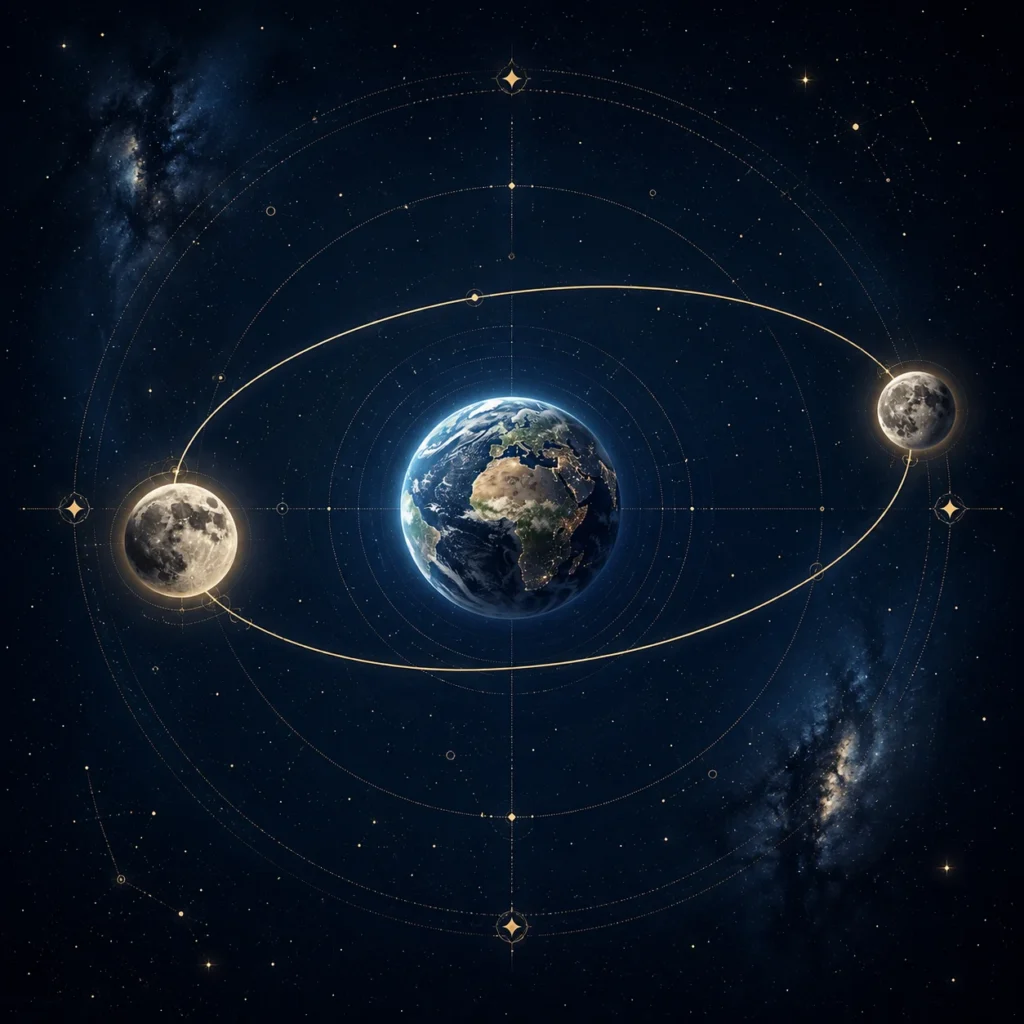
What do apogee and perigee mean?
The Moon’s orbit around the Earth is not perfectly circular. Therefore, the distance between the two celestial bodies varies throughout the month.
Perigee
The perigee refers to the moment when the Moon is closest to Earth in its orbit.
When a full moon occurs near perigee, it can appear slightly larger and brighter. This phenomenon is often referred to by the popular term « supermoon ».
Apogee
Apogee is the point where the Moon is farthest from Earth.
It may then appear slightly smaller in the sky.
Astro PRO marks these two events directly in the calendar to help you more accurately track lunar movements.
Solar Eclipses in Your Calendar
A solar eclipse can occur during a new moon when the Sun, Moon, and Earth are sufficiently aligned.
The Moon then partially or completely obscures the Sun from certain regions of the world.
Not every new moon causes an eclipse, as the Moon’s orbit is slightly tilted compared to Earth’s orbit around the Sun.
When a solar eclipse is anticipated, Astro PRO indicates it in the calendar with available information about the event.
In an astrological reading, an eclipse is often seen as a particularly significant new moon, associated with a period of transition or the beginning of a new cycle.
Observe an Eclipse Safely
Never look directly at the Sun without a protection specifically designed and certified for solar observation. Standard sunglasses do not provide sufficient protection for your eyes.
How to use the Astro PRO lunar calendar?
1. Check the phase of the day
Discover the current appearance of the Moon, whether it is waxing or waning, and the astrological sign it is passing through.
2. Explore the upcoming days
Navigate through the calendar to see the daily evolution of the lunar phase and the upcoming sign changes.
3. Identify important events
The full moons and new moons, solar eclipses, apogee, and perigee are clearly marked in the calendar.
4. Activate your notifications
Choose the events for which you want to be alerted directly from your profile settings.
Lunar calendar and personalized horoscope: what’s the difference?
The lunar calendar shows the movements of the Moon in general terms. It indicates its phase, its sign, and the main upcoming astronomical events.
Your personalized horoscope analyzes how the movements of the Moon and other planets interact with your sign, rising sign, and astrological profile.
The two tools are complementary:
- the calendar allows you to observe the lunar cycle;
- the horoscope helps you place current influences within your personal profile;
- the sky chart presents the current positions of various celestial bodies;
- your natal chart describes the sky at the moment of your birth.
Does the Moon really influence our emotions?
The Moon’s gravitational influence on Earth is indeed real and plays a significant role in tides.
On the other hand, the associations between lunar phases, zodiac signs, and emotions are a matter of astrological interpretation. They do not allow you to predict your mood or behavior with certainty.
The lunar calendar can be used as a tool for observation, a symbolic reference, or an invitation to regularly step back and reflect on your personal rhythm.
Is the lunar calendar free?
The complete lunar calendar is accessible for free after creating your Astro PRO profile.
You can check the upcoming phases of the Moon, the signs it moves through, and the key events of the cycle.
You can also customize your notifications to receive alerts for new and full moons.
Follow the upcoming lunar cycles
Discover the lunar phase for each day, the sign the Moon is in, and the next important dates.
Full moon, new moon, apogee, perigee, or solar eclipse: find all the events in a clear and easy-to-consult calendar.